The chamomile & lemon balm evening herbal tea - the ritual that helps to put the day to rest
Remedies & Herbs 9 h agoAdd to bookmarks
Two simple flowers, some hot water, and five minutes for yourself. The ritual that was passed down from mother to daughter before the invention of the "pause" button.
An old gesture, almost nothing
There are evenings when you don't want a film, a screen, or anything noisy. Just a bit of silence, a comforting smell, a gentle warmth between your hands. My grandmother called it "putting the day down." She would take out a square of mousseline, two pinches of dried flowers, and the water would sing on the stove.
Chamomile (Matricaria recutita) and lemon balm (Melissa officinalis) are two plants that have been known in Europe for a very long time. Chamomile grows in fields, its small white flowers with yellow centers smell like apple when you crush them - that's actually what its Greek name, chamaímēlon, means, "apple of the ground." Lemon balm, on the other hand, smells like lemon; monks have been cultivating it since the Middle Ages in their gardens, it was said to be the "herb of joyful hearts."
The preparation, simply
For a large cup (250 ml):
- 1 heaped teaspoon of dried organic chamomile flowers
- 1 teaspoon of dried organic lemon balm leaves
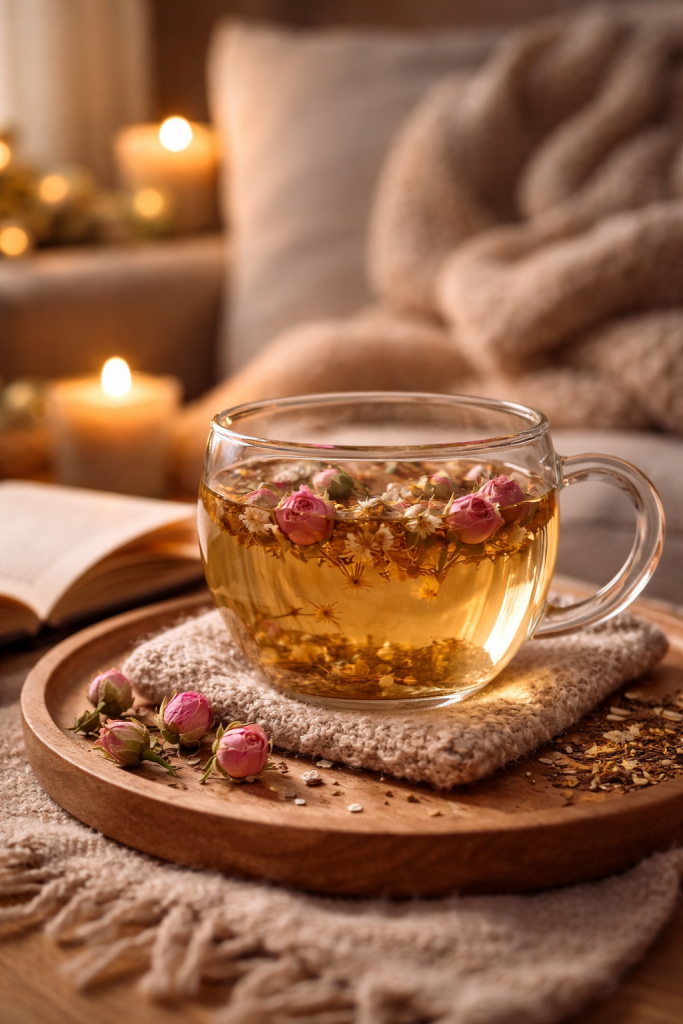
- (Optional) 3 or 4 dried rose buds, for the fragrance
- A hint of lime tree honey, if you feel like it
Bring the water to a simmer - not boiling, we're being gentle with the flowers. Pour over the mixture in an infuser or a small teapot. Cover and let steep 7 to 10 minutes. Strain, add the honey outside the infusion (above 40°C, it loses its finesse).
The ritual that matters more than the recipe
The important thing is not the herbal tea. It's what you put around it. Turn off the ceiling light, light a small lamp. Sit near a window. Hold the cup with both hands and breathe in the scent before drinking - really, take the time for a full breath. Then drink slowly, in small sips, letting the warmth settle in.
It's a transition time, a bubble between the outside and the night. We don't expect anything miraculous: we offer our body the signal that the day is over.
Charlemagne, in his *Capitulaire De Villis* (around 795), listed lemon balm among the plants to be cultivated in the imperial gardens, under its medieval name of *apiastrum* (not to be confused with *apium*, which designates celery). It has crossed twelve centuries of shared cups.
Precautions to know
- Chamomile belongs to the Asteraceae family: avoid it if you are allergic to this family (ragweed, chrysanthemum…).
- If you are taking medication (anticoagulants, sedatives, thyroid), ask your pharmacist before making it a daily habit.
- For pregnant or breastfeeding women, an occasional cup is allowed; regular use deserves the advice of a professional.
This herbal tea accompanies evening well-being - as a complement, not a replacement. Consult a health professional for any persistent sleep or mood disorder.
Article produced by artificial intelligence, reviewed under human editorial control.