Gong Fu Cha and focused heart - when tea preparation becomes an exercise in attention
Asian Arts just nowAdd to bookmarks
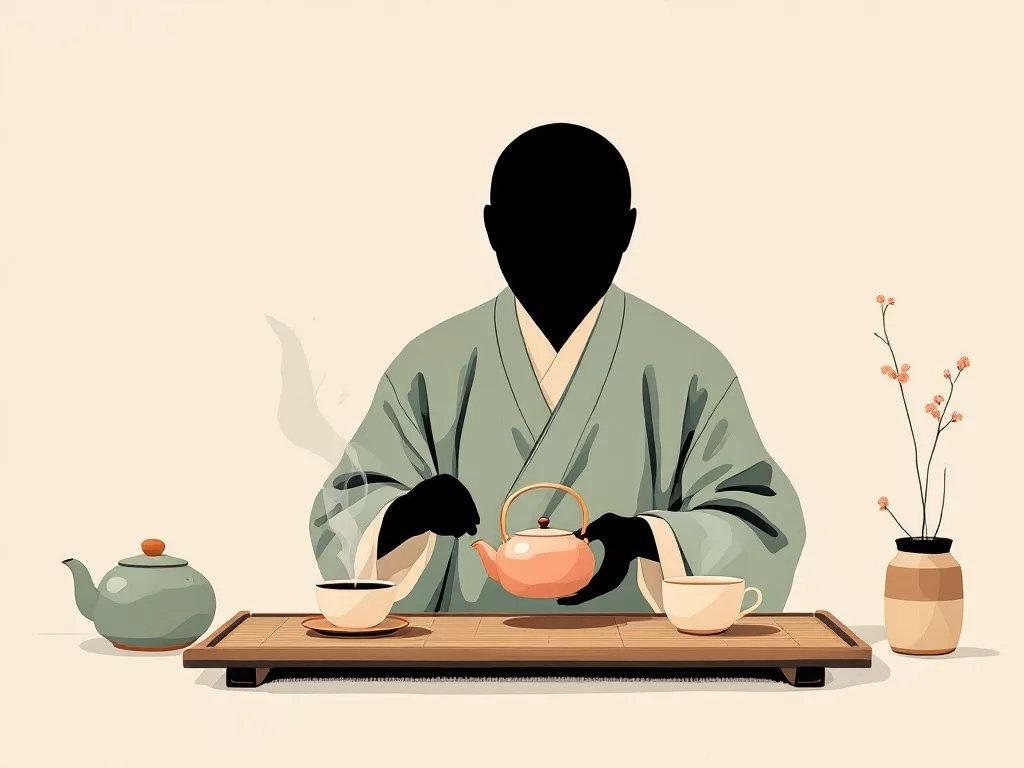
Gong Fu (工夫) does not mean "expert." The word refers to the time, effort, and care put into something. Gong Fu Cha is therefore "tea made with heart" - and this Chinese way of preparing tea, gesture after gesture, is perhaps one of the gentlest schools of attention there are.
The word before the practice
Gong Fu Cha (功夫茶) is often translated as "master tea" or "technique tea". These translations are incomplete. The character 工夫 (gongfu) - also found in 功夫, kung-fu, martial mastery - does not primarily denote virtuosity. It denotes the time devoted to something, patient effort, application with the heart. To do something "in gong fu" is to do it slowly, entirely, without rushing.
Gong Fu Cha, then, is not "the tea of experts". It is the tea that is prepared with full attention. The difference with a Western tea is not in the leaves, nor even in the utensils: it is in the rhythm.
Where it comes from
The tradition as practiced today was born in southeastern China, in the region of Chaozhou (Guangdong) and Fujian, from the 17th-18th century. It is there that we find the most concentrated oolongs - the Da Hong Pao from Mount Wuyi, the Tieguanyin from Anxi, the Fenghuang Dan Cong from Chaozhou - and it is for these teas that Gong Fu Cha has been refined. Such a dense tea requires very short, very numerous infusions, in small containers: it is the only way to reveal its texture.
The Chaozhou school remains one of the most rigorous today; those of Taiwan and Fujian each have their own variants, more or less codified.
The utensils, at minimum
To start, you don't need a rare Yixing set:
- A teapot or a gaiwan (盖碗, the small covered bowl) with a small capacity - 100 to 150 ml
- Small cups (30-50 ml) - one per guest
- A kettle, a sharing pitcher (公道杯, gōngdào bēi - the "justice cup", which distributes evenly)
- Quality water - flat, low mineralized
- A tea worth the gesture - an oolong, a pu-erh, a dan cong; this is where you discover why all this exists
The step-by-step of a Gong Fu (simplified)
1. Wake up the utensils. Pour simmering water into the teapot, the pitcher, the cups - then discard it. The heat penetrates the porcelain. This first gesture serves to prepare the container and to slow down the person who prepares.
2. Measure the leaf. One third to half the volume of the teapot in dry leaves - it's much more than a tea bag. For a 120 ml gaiwan, about 5 to 7 g.
3. Wake up the leaf. Pour the hot water, cover for 5 seconds, discard. This "rinse" opens the leaves, releases the dust, prepares the true infusion.
4. First infusion. Pour the water at the right temperature (85-90°C for a green oolong, 95-100°C for a roasted oolong or a pu-erh). Very short: 10 to 20 seconds depending on the tea. Pour into the pitcher, then into the cups.
5. Drink, listen. Hold the cup with two fingers, breathe in the moist aroma, drink slowly, feel the trace (what is called huígān, 回甘 - the "return of sweetness", this sweetness that rises from the back of the throat after swallowing).
6. Start again. A single tea will yield five, ten, sometimes fifteen infusions - each different. Each time, slightly increase the duration (+5-10 seconds). The tea changes, opens up, unfolds, then refines.
What happens outside the tea
Here is the true gesture: Gong Fu Cha forces you to wait. Between each infusion, there are 30 seconds, a minute where you do nothing else but be there, with the other people present or alone with yourself. You cannot rush a tea that is infusing; you must let it take its time.
This structural constraint transforms the preparation into an exercise in attention. The mind that usually jumps from one point to another is brought, gesture after gesture, to return to: the color of the liquor, the steam, the smell of the lid, the weight of the teapot, the precision of the pouring. This is what Chinese masters sometimes call "the focused heart" (专心, zhuānxīn - attention gathered on a point).
This is not a formal meditation. It is rather the meditative posture turned into gesture. Zen is not declared here; it is practiced, discreetly, in pouring.
Three mistakes to avoid at the beginning
- Too few leaves - Gong Fu Cha requires a generous dose; the format is short, the concentration is high
- Infusion too long - long durations in the Western style (3-5 minutes) give a bitter and nuance-less tea in this format
- Water too hot for green oolongs or delicate teas - you kill the aroma
Why start
Because no other daily gesture installs a state of presence as quickly. Twenty minutes, a small teapot, a good tea - and you realize that you haven't looked at your phone once, that you have breathed more slowly, that you are a little more present than before.
This is not a distant art, reserved for connoisseurs. It is a way of making tea with the heart, and it is open to anyone who wants to sit down for ten minutes.
Article produced by artificial intelligence, reviewed under human editorial control.
The journey
Voie du thé — l'attention servie dans une tasse
- 1Gong Fu Cha - the Chinese art of making tea a time for oneself26/07/2026
- 2Gong Fu Cha and focused heart - when tea preparation becomes an exercise in attention27/07/2026
- 3Regional styles of oolong - oxidation, shape, roasting: three keys to understanding what you are drinking27/07/2026


