The phacelia, that purple cushion that welcomes bees in the heart of summer
Nature 4 h agoAdd to bookmarks
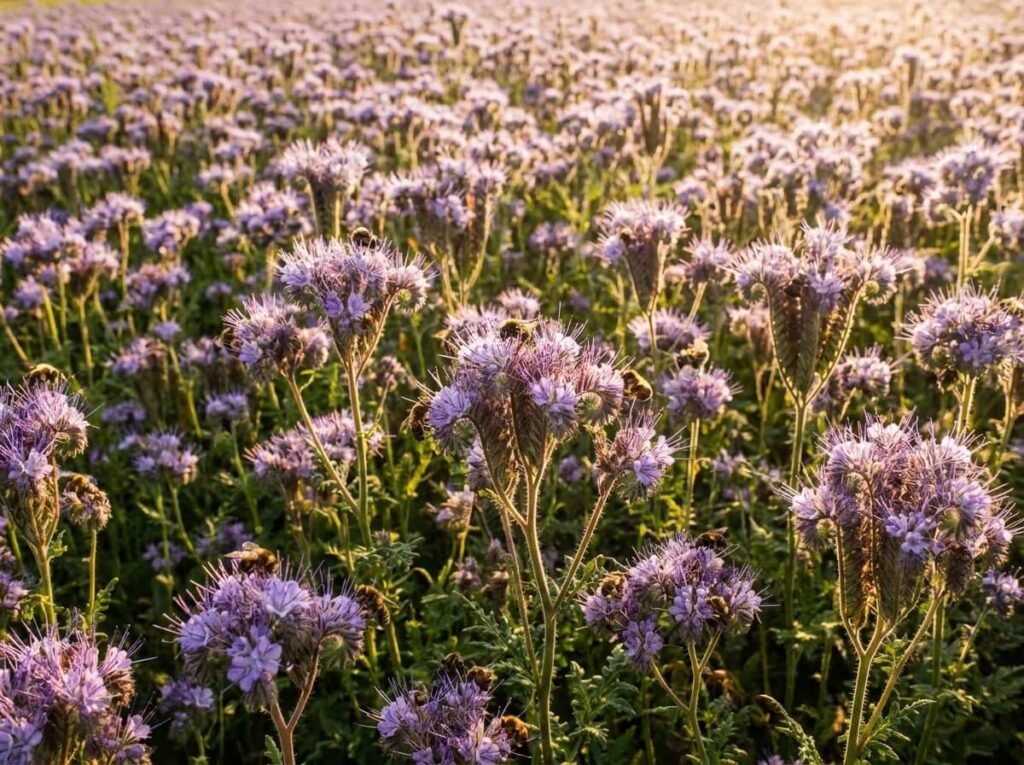
A light sowing, a blooming in blue-lavender swirls, and suddenly the garden buzzes. Phacelia is the plant of simple summers - for pollinators, for the soil, for the eye.
A plant from America, adopted by our bees
Phacelia (Phacelia tanacetifolia) is native to the southwestern United States. It arrived in Europe in the 19th century, discreetly, in the suitcases of botanists. Today, it has found a place in our gardens and in the flower strips of agricultural farms - not because it is spectacular, but because it is deeply generous.
Its flowers, in spikes curled like fine volutes, tend towards lavender-blue. They unfold in finely cut foliage, almost serrated. It looks like a cushion of mauve mist placed right in the vegetable garden.
A feast for the foragers
What strikes you as you approach is the sound. A phacelia in full bloom is noisy: domestic bees, earth bumblebees, hoverflies, butterflies. It regularly appears in the top plants for honey production - several gardening sources cite it among the best for nectar production per square meter.
It also has the rare quality of flowering in the heart of summer, when many other melliferous flowers have faded.
A simple gesture, at the end of summer
- The soil. Ordinary, well-drained. Phacelia is not demanding.
- Sowing. Broadcast, on a scratched board, at a rate of about 1.5 g per square meter. Cover very lightly, tamp with the back of the rake, water in fine rain.
- The season. From March to September. A sowing in late July will flower in September - a late gift for the foragers.
- Next. Six to eight weeks after sowing, it flowers. The flowering lasts three to four weeks.
A friend of the soil
Phacelia is also an excellent green manure. Its fasciculated roots go down, decompact, structure the soil. Once the flowering is over - or just before, if you prefer to deprive it of seeds and avoid spontaneous sowing -, it is mowed and buried or left as mulch.
It belongs to the family of Hydrophyllaceae, distinct from those of the common vegetable garden (Solanaceae, Cucurbitaceae, Brassicaceae, etc.). Result: it breaks the cycles of parasites and fits everywhere in the rotation.
What it teaches
There is something very wabi-sabi about phacelia: it does not seek to be spectacular. Its flowers are small, its stems sag after a few weeks. But in this ephemeral, an entire people of foragers come to drink.
Look at it one morning, coffee in hand. Five minutes are enough to understand why gardeners talk about it with a touch of tenderness.
Precautions
No plant is completely harmless - phacelia can cause, in very sensitive people, a slight skin irritation on contact with the sap. Wear gloves if you know you have reactive skin.
Article produced by artificial intelligence, reviewed under human editorial control.