Gong Fu Cha - the Chinese art of making tea a time for oneself
Asian Arts just nowAdd to bookmarks
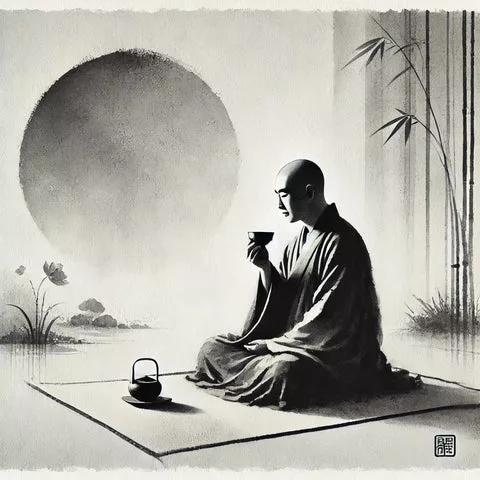
Small teapots, tiny cups, repeated gestures: Gong Fu Cha is not a spectacular ritual, it's a long exercise in attention. A journey to Chaozhou, the cradle of a way of drinking tea that takes its time.
Gong Fu Cha - the Chinese art of making tea a time for oneself
There is, in China, a way of making tea that is not at all solemn. No ceremonial robe is worn; no text is recited. One sits in front of a small striated wooden tray, heats a tiny teapot, empties it, fills it, empties it again. The gestures are modest, almost monotonous. And yet, an hour later, one gets up a little different: slower, more attentive, less eager to finish the day.
This way of doing things is called 功夫茶 - gōngfū chá - usually translated as tea with effort and patience. Gōngfū (功夫) does not mean "martial arts": it is the Chinese word for any skill acquired through repeated work - calligraphy, cooking, dance. Applied to tea, it designates the art of slowly infusing, many times, in very little water, with many leaves, paying equal attention to each step.
Chaozhou, a small port and a long tradition
The cradle of Gong Fu Cha is not Beijing, nor Shanghai. It is Chaozhou (潮州), a city of water and canals in the east of Guangdong, a few hundred kilometers from Hong Kong. The Teochew (潮州人) - the diaspora that spread from Chaozhou to Singapore, Malaysia, and Thailand - have carried their brewing style wherever they went. It was refined there, in the 17th-18th centuries, around a local tea: the Phoenix Dan Cong (凤凰单丛), an oolong from the mountains of Fenghuang, whose old trees yield cups aromatic as ripe fruits.
This "Chaozhou" Gong Fu Cha is distinguished from a more general Gong Fu Cha spread elsewhere in China by one thing: the teapot is made of zhuni (朱泥), a very fine red clay, tiny (often 60 to 100 ml), and the cups are even smaller - three cups, one per guest, or per turn. The gesture clings to the teapot, which becomes the central object of the table.
What really happens on the tray
The principle is simple to describe, less easy to do:
- Many leaves, little water - the teapot is filled one-third, sometimes halfway, with rolled leaves. The ratio is the opposite of a European teapot.
- Very short infusions - the first ones last 10 to 15 seconds; the following ones, a little longer.
- Many infusions - a good oolong will yield 6, 8, sometimes 12 successive cups, each different from the previous one.
- Rinse the leaves - the very first infusion, very quick, is discarded. It wakes up the leaf, cleans it of dust, and perfumes the teapot and cups as it passes.
- Serve in order - the host circulates the teapot above the cups in a continuous movement, so that the first cup is not stronger than the last.
The wooden tray (chá pán 茶盘) collects the overflowing water; one can water the teapot to keep it warm. Nothing is lost, nothing is neat: the water trickles, drips, gathers.
A good Phoenix Dan Cong or a Tieguanyin (铁观音) easily holds 8 to 12 short infusions. Each cup has a different character: the first ones are floral, the following ones rounder, the last ones mineral. Gong Fu Cha is not a way to get to the aroma faster: it is a way to watch it change.
Why gōngfū - the effort that makes one attentive
For a hurried reader, the question comes quickly: why do all this, since one could put three grams of leaves in a large teapot and do something else while it infuses? The practitioners all answer more or less the same thing: it is not a more efficient way to make tea, it is a slower way, on purpose.
The word gōngfū says it. A skill that takes time. One repeats the same gesture - pour, drain, serve, drink - until the gesture becomes fluid, then, one day, almost invisible. It is not an official spiritual exercise; it is a discreet exercise of presence, done while doing something else (receiving a friend, listening to music, talking business, or just being alone).
Many contemporary practitioners - and several texts that associate Gong Fu Cha with chán (禅) sensitivity, the Chinese Buddhist school whose Japanese zen is the heir - describe the same experience: by repeating the same tiny gestures, the mind that runs eventually slows down. Not because the tea "does something", but because one is busy doing something simple, well.
The art of being bored - a word that practitioners like
A recent text by a tea master, published by Path of Cha, calls this "the art of being bored" - the art of being bored. The phrase is beautiful and deliberately provocative. It means: accepting that nothing spectacular happens. The tea will not change life in one session. The gestures are not very interesting. The infusions look all the same. And it is precisely by holding on in this "apparent boredom" that one discovers, cup after cup, the infinitesimal changes in the aroma, the way the hot water warms the palm, the slightly more settled voice of the person sitting opposite.
Nothing mystical about it - a form of training in patience, slow conversation, gratuitous observation. It is an art of living, not a treatment.
To start at home - the minimal gesture
One can do Gong Fu Cha without buying rare objects. The minimum kit fits on a coaster:
- A small teapot or, even simpler, a gaiwan (盖碗) - the small Chinese covered bowl, about 100 to 150 ml. One can find them for a few dozen euros.
- Small cups the size of a shot (30 to 50 ml).
- A tea that supports multiple infusions: an oolong (Tieguanyin or Dan Cong), a young raw puerh, a good quality red tea.
- A carafe to empty the teapot properly.
- A little space - a tray, a folded towel to collect the drops.
Then, the gesture:
- Scald the teapot and cups; pour the hot water.
- Put the leaves (count 4 to 5 g for a 100 ml gaiwan, i.e., a good third of the capacity in dry leaves).
- Pour very hot water to the edge; close.
- Count five seconds. Empty completely into the carafe. Discard this first infusion (or pour it over the cups to perfume them).
- Pour again, this time 10 to 15 seconds. Serve in the cups.
- Drink in small sips, observing how the aroma evolves between the hot cup and the cooling cup.
- Repeat, lengthening each infusion by 5 to 10 seconds.
If you are a beginner, the gaiwan is a better starting point than the clay teapot. It absorbs nothing, rinses easily, and allows you to taste the same leaf without a previous tea interfering with the next one. Yixing or zhuni teapots, very absorbent, are dedicated to a single type of tea - it is a commitment, not a first purchase.
What Gong Fu Cha is not
A word finally on the misunderstandings.
Gong Fu Cha is not the Japanese tea ceremony (chanoyu 茶の湯). The Japanese ceremony, with its beaten green tea matcha and its precise choreography, is a distinct art, born in a different context (the zen of the Rinzai monasteries, the codification by Sen no Rikyū in the 16th century). The two traditions respond to each other - Gong Fu Cha has probably influenced the sensitivity that gave birth to chanoyu - but they do not confuse.
Gong Fu Cha is not either a "medicinal tea". One does not do Gong Fu Cha to heal oneself or to reach a state. One drinks good tea, slowly, in small cups, because it is pleasant and it soothes. The rest - attention, calm, pleasure of receiving - comes alone, as an accompaniment.
It is this accompaniment, quiet and lasting, that the way of tea offers: not a remedy, but a company. A gesture that one can repeat every day, when one wants, without having to believe in it.
Article produced by artificial intelligence, reviewed under human editorial control.


