Hyssop, the herb of cloisters - fragrance of the garrigue and monastic ritual
Remedies & Herbs 25 min agoAdd to bookmarks
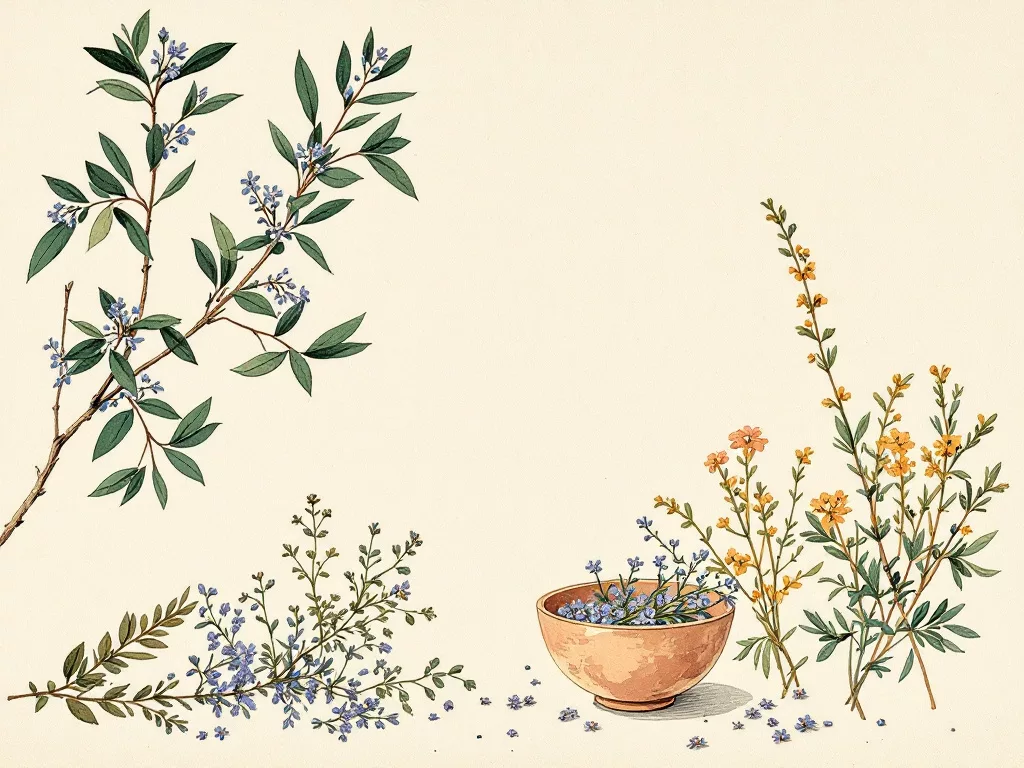
Rediscover a humble aromatic plant, long entrusted to the gardens of monks and the formulas of Hildegard of Bingen.
There are plants that come back in waves. Hyssop (Hyssopus officinalis) is one of them: forgotten and then rediscovered, it belongs to this discreet family of herbs that were once kept in cloister gardens, between rosemary and sage, without paying it particular attention. Yet, it was found in the Physica of Hildegarde de Bingen (12th century), who speaks of it as a plant "that purifies" - in the medieval sense of the word, closer to the symbolic gesture than to modern pharmacology. This summer, I propose to take a closer look at it.
The plant
Hyssop is a small sub-shrub of the Lamiaceae family (like lavender, thyme, mint). It grows spontaneously on the calcareous and dry soils of the Mediterranean region, from Spain to Iran. Thin, elongated leaves, of a grayish green that reminds one of rosemary. Blue-violet flowers (sometimes pink or white depending on the cultivars) in dense spikes at the top of the stems, very loved by bees. It is recognized by its scent: camphorated, a bit resinous, with a softer note than that of rosemary - it is sometimes said that it smells "like the garrigue in the morning".
A plant of cloister gardens
Hyssop is mentioned in the Bible, cultivated in Benedictine gardens since the Middle Ages, and is part of the plants that Hildegarde de Bingen, a Rhineland nun of the 12th century, describes in her book Physica devoted to the virtues of created things. With her, it belongs to the universe of remedies that are prepared in the monastery: infusion, decoction, maceration in wine. These recipes should be read as traces of a tradition - not as a modern pharmacopoeia. It is also found in the composition of several ancient monastic liqueurs, of which Chartreuse is perhaps the most famous heir.
An infusion to discover its taste
The simplest gesture to familiarize oneself with hyssop is to drink it pure before marrying it with something else.
- Dried flowers: 1 heaping teaspoon per cup
- Simmering water (not boiling), 200 ml
- Pour over the flowers, cover, let infuse 5 to 7 minutes
- Filter
The taste: herbaceous, camphorated, with an elegant bitterness at the end of the mouth. You can soften it with a little garrigue or thyme honey.
In a blend for the evening
What I like about hyssop is that it "holds up" very well next to other plants. For an evening herbal tea, try:
- 1 teaspoon of hyssop
- 1 teaspoon of lemon balm
- 1 teaspoon of lime flowers
Same infusion method. You get an aromatic cup, with the lemony sweetness of lemon balm and the floral envelope of lime, where hyssop brings its resinous note that reminds one of the garrigue at sunset.
Precautions - important
Hyssop, like many powerful aromatic plants, is not harmless:
- To be avoided absolutely during pregnancy and breastfeeding.
- To be avoided in people with epilepsy or prone to convulsions: the essential oil of hyssop officinale contains pinocamphone, known to be neurotoxic in high doses.
- Do not confuse with the essential oil: the traditional use in infusion of dried flowers is much softer, but the essential oil of hyssop remains contraindicated in domestic use - it is a professional product.
- In case of doubt (ongoing treatment, chronic pathology), ask advice from a pharmacist or a qualified herbalist.
In the garden
Hyssop likes poor, dry, well-drained soil, in full sun. It tolerates drought, but not heavy and humid soils in winter. Sowing in the spring or planting a pot. It flowers from July to September: this is the time when the flowering tops are harvested, to be dried head down, in the shade, in a ventilated place.
And a last pleasure: bees, solitary wasps and butterflies do not make a mistake. A border of hyssop in a dry corner is a good gesture for pollinators, in addition to a reserve for the winter herbal tea.
As always, the herbal tea accompanies a moment, it does not replace anything. As a complement, not as a replacement - consult a health professional.
Article produced by artificial intelligence, reviewed under human editorial control.
The journey
Tisanes du soir — plantes qui aident à déposer la journée
- 1The lemon balm - the herb of endless summer evenings20/07/2026
- 2**Mullein - the bitter plant of cloisters that helps to get through colds**20/07/2026
- 3Thyme & lemon verbena evening - the cup that sets the summer evenings26/07/2026
- 4Hyssop, the herb of cloisters - fragrance of the garrigue and monastic ritual28/07/2026


