Thyme & lemon verbena evening - the cup that sets the summer evenings
Remedies & Herbs just nowAdd to bookmarks
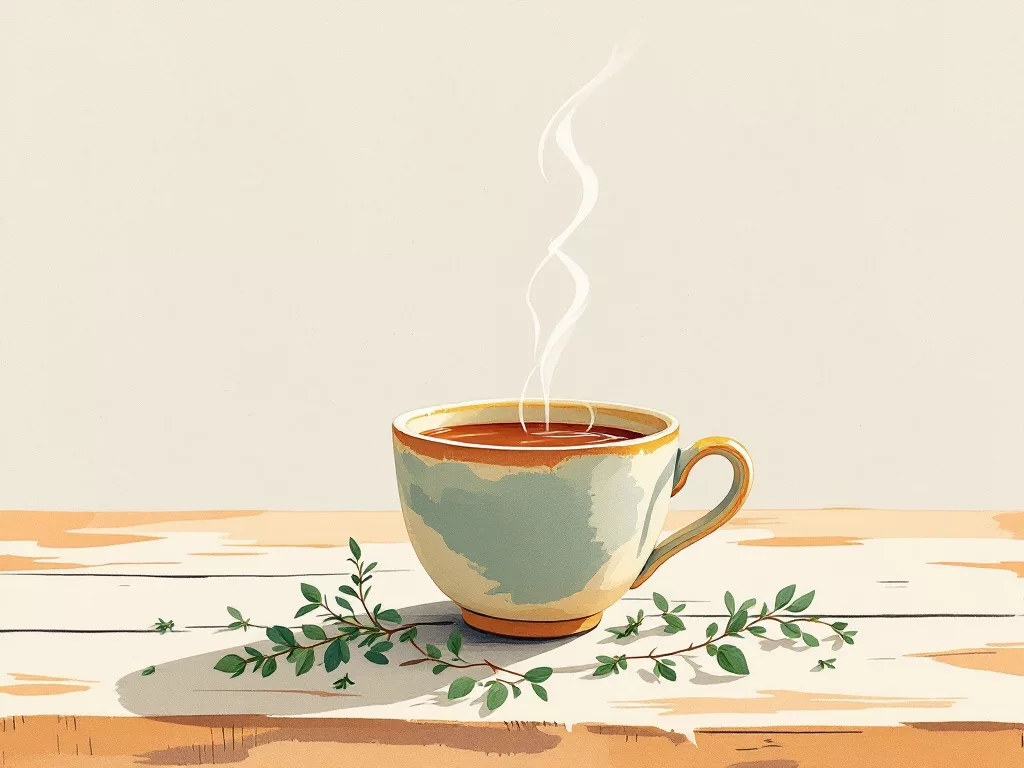
There are summer evenings when you come home more tired than you thought - the heat, the journeys, the people. A simple infusion of thyme and lemon verbena, lukewarm, barely sweetened, is enough to calm the body's agitation. Here's how I prepare it.
Thyme & lemon verbena for the evening - the cup that sets the summer evenings
We often associate thyme with winter, with the simmering soup, with the little cold that we try to contain. This forgets that thyme, a plant of stone and sun, is also a friend of summer evenings - when you come back with your back a little stiff, your head full, and you want to gently prepare for sleep without going through a glass of alcohol or another screen.
Married to lemon verbena, it gives a very simple, aromatic, frank infusion: the slightly peppery and resinous side of thyme, softened by the lemon-vanilla note of the verbena. A warm cup rather than burning, a little honey if you feel like it, and you really sit down.
The two plants, in two words
Common thyme (Thymus vulgaris L.) is a low shrub of the Mediterranean garrigues. It is found wild on all the limestone hills of Provence and the Mediterranean coast. It has been cultivated since Antiquity - the Egyptians used it in embalming, the Greeks and Romans in baths and fumigations. In cooking, we all know it; as an herbal tea, we like it less, wrongly. Well prepared, it gives a clear, amber, warm liquid.
Lemon verbena (Aloysia citrodora Palau, formerly Lippia citriodora) is another plant - be careful not to confuse it with official verbena (Verbena officinalis), a European plant with a bitter taste, used in a completely different context. Lemon verbena comes from South America (Argentina, Chile, Peru); it was brought to Europe at the end of the 18th century and has acclimatized very well in southwestern France. It is this one, with elongated and fragrant leaves, that we find in our grandmothers' gardens and that we pick in the summer to dry.
In herbalism, we carefully distinguish **lemon verbena** (Aloysia citrodora), with a lemon scent, used in evening herbal tea, and **official verbena** (Verbena officinalis), a native European plant with a bitter taste, used since Antiquity but in a completely different context. On a herbal sachet, check the Latin name carefully.
The preparation, very simple
For a nice teapot (two cups):
- 1 heaped teaspoon of dried thyme (leaves and flower tops) - about 2 g.
- 1 heaped teaspoon of dried lemon verbena - about 2 g.
- 500 ml of simmering water, not boiling with large bubbles.
- A drizzle of honey (optional, but a good lime honey or summer flowers goes very well).
We proceed as follows:
- Heat the water just before boiling. Too violent water breaks the aromas of the verbena.
- Pour the water over the plants in a teapot or jug.
- Cover - this is important: the essential oils of thyme and verbena evaporate, we want to keep them in the teapot.
- Let infuse 7 to 10 minutes.
- Filter, serve warm rather than burning, add the honey after (never in very hot water, honey does not tolerate high temperature well).
You can drink it as is or, in summer, let it cool and serve it barely warm, with a slice of lemon.
When and how to drink it
For the effect to be really soothing, the best is to drink it:
- 30 to 45 minutes before going to bed, to let the body digest without having to get up at night;
- sitting, without screen, a low lamp lit if possible;
- in small sips, taking the time to smell the aroma.
It is a ritual as much as an herbal tea. The gentle warmth in the hands, the smell that rises, the fact of doing nothing else for ten minutes but drinking this cup - that is what soothes, as much as the plants themselves.
Precautions to know
Thyme in infusion, at the usual dietary dose (2 g per cup), is well tolerated by most adults. However:
- Pregnancy and breastfeeding: out of caution, avoid regular or significant consumption of thyme during pregnancy. Essential oil of thyme, on the other hand, is strongly discouraged. For an occasional herbal tea, ask your midwife or doctor.
- Young children: for the very young, we prefer softer plants (orange blossom, lime blossom, verbena alone).
- People under medical treatment: thyme can interact with certain anticoagulants; out of caution, ask your doctor or pharmacist.
- Allergies to Lamiaceae (thyme, rosemary, mint, sage): obviously, avoid.
And for everything related to a real sleep disorder, to a lasting fatigue or to an anxiety that disrupts daily life: this cup is there to accompany, not to replace a real rest time or medical support. As a complement, not a replacement - consult a health professional.
A word to finish
My grandmother made this herbal tea almost every evening in July and August. She said - I see her again - "It's so that the day goes away." It's not very scientific, but it's very accurate: the cup does not make you sleep, it makes you settle. Sleep, then, comes alone, when it wants to.
Try for three nights in a row. You will see: the gesture, very quickly, becomes more important than the drink.
Article produced by artificial intelligence, reviewed under human editorial control.
The journey
Tisanes du soir — plantes qui aident à déposer la journée
- 1The lemon balm - the herb of endless summer evenings20/07/2026
- 2**Mullein - the bitter plant of cloisters that helps to get through colds**20/07/2026
- 3Thyme & lemon verbena evening - the cup that sets the summer evenings26/07/2026


