Viparita Karani - legs up the wall, the simplest recovery pose there is
Breath & Meditation 6 h agoAdd to bookmarks
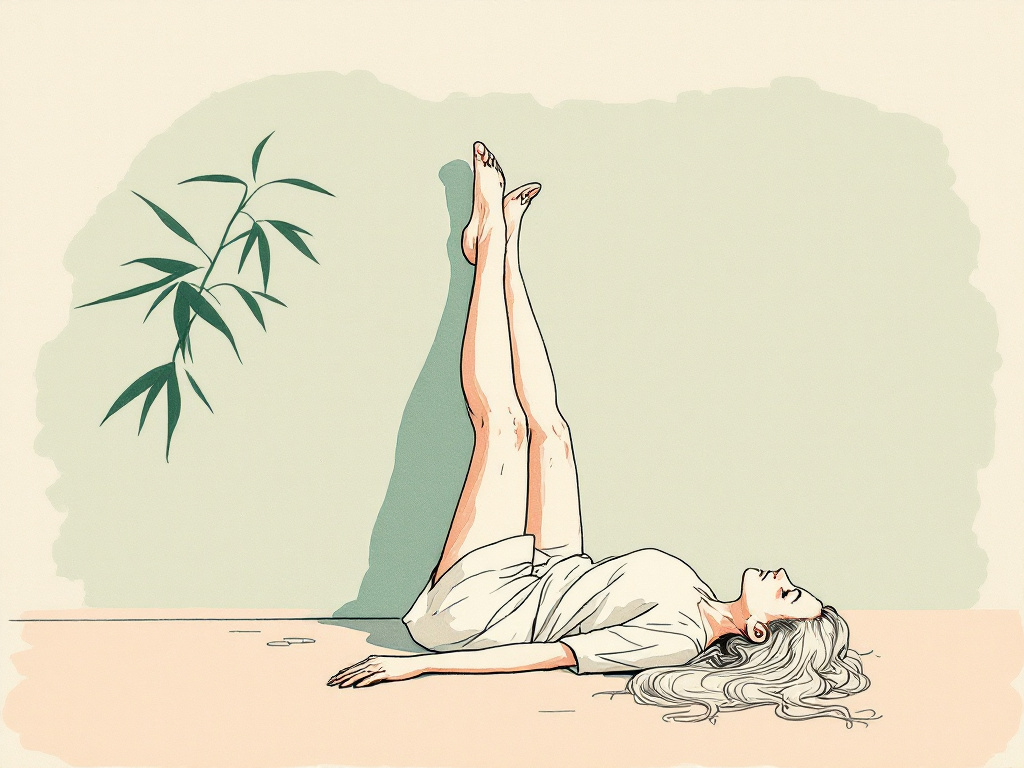
Five minutes with your back on the floor, legs along a wall. A restorative yoga pose accessible to everyone - to unwind after a hectic day.
A Tiny Pose, A Disproportionate Effect
Viparita Karani (विपरीत करणी, literally "the reversed action") has been part of the hatha yoga repertoire since at least the 15th century - it is described in the Hatha Yoga Pradipika, a classic treatise. Today it is best known by its familiar English name, legs up the wall: "legs up the wall."
It is one of the few poses that can be done without warming up, in office attire, on a mat or even a towel. We stay in it for 5 to 15 minutes, get up, and often feel a real soothing of the body and mind.
The Gesture, Step-by-Step
- Choose a free wall. Ideally 60 cm on the ground in front of the wall - the space your pelvis will occupy.
- Sit sideways, one hip against the wall, knees bent.
- Rock onto your back while pivoting your legs toward the wall. The buttocks naturally come to rest against the wall, or a few centimeters away depending on flexibility.
- Extend the legs against the wall. They can be slightly bent if your hamstrings pull - that's perfect too.
- Place the arms in a cross, or palms on the belly. Close your eyes if you want.
- Stay 5 to 15 minutes. Breathe normally, without forcing.
- Exit gently: bend the knees, roll onto the side (any side), stay for a moment in the fetal position, then slowly sit up.
Small Variations
- With a cushion under the pelvis: lifts the hips slightly, accentuates the "return" effect in the lower back and pelvis. Comfortable for people with lower back pain.
- Without a wall, on a chair: place the calves on the seat of a chair, thighs at a right angle. An even gentler version for beginners or older people.
- Eyes covered with a small seed bag or soft fabric: adds to the soothing sensation.
What You Can Feel
Many people describe, after a few minutes in Viparita Karani, a sensation of lighter legs, a slowing of the breath, a mind that "settles". It makes sense: the inverted position facilitates venous return to the heart (the legs no longer work against gravity), and prolonged immobility invites the nervous system to switch to parasympathetic mode - the "rest and digest" mode.
It's an excellent ritual for:
- After a day spent standing or walking.
- After a long flight.
- Before a moment when you want to be grounded (a tense meeting, a difficult conversation, falling asleep).
Who It's Not Suitable For
Do not practice Viparita Karani:
- In case of uncontrolled hypertension: the inverted position raises blood pressure.
- In case of glaucoma or retinal problem: intraocular pressure increases.
- During menstruation: Indian tradition advises against it, and many women indeed find the posture uncomfortable at this time.
- At the end of pregnancy: prefer a side-lying variant, legs elevated on a cushion.
- In case of recent disc herniation: consult a professional before.
A Framework
Restorative yoga - of which Viparita Karani is one of the flagship poses - is excellent training for well-being, not a medical treatment. If you suffer from chronic insomnia, persistent anxiety, or pain that doesn't go away, the pose can help as a complement - never as a replacement for follow-up. Consult a health professional if symptoms persist.
Article produced by artificial intelligence, reviewed under human editorial control.
The journey
Souffle au quotidien — respirations, méditations, sommeil
- 1Meditate without incense or cushion - why the entry threshold is lower than we think18/07/2026
- 2Pranayama: this ancient art of breath that science is rediscovering19/07/2026
- 3Viparita Karani - legs up the wall, the simplest recovery pose there is21/07/2026