Qi Gong to get started - three gestures, one breath, an art of living
Asian Arts 10 h agoAdd to bookmarks
Neither performance nor prowess: Qi Gong (氣功) is practiced standing, almost motionless, accessible to all bodies. Opening the door is already the essence.
An ancient practice, a misunderstood word
Qi gong - 氣功, literally "work (功 gōng) of breath-energy (氣 qì)" - is neither a gentle gymnastics in the Western style, nor an immobile meditation. It is a practice of slow movements, coordinated with breathing and intention, transmitted in China for more than two thousand years. The earliest figurative traces, the Daoyin tu (導引圖) discovered at Mawangdui, date back to the 2nd century BCE: one can see painted silhouettes that stretch, open, and close. Nothing has really changed.
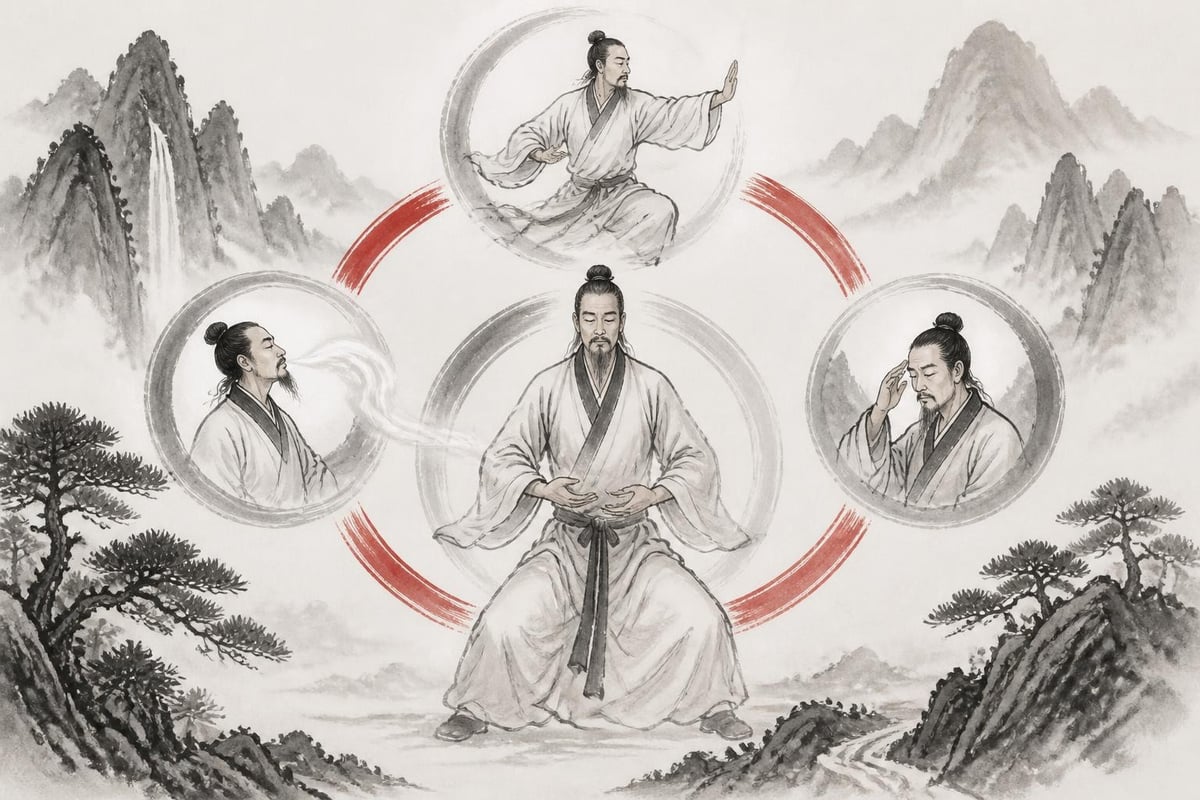
What qi gong seeks is not performance. It is a state: the body aligned, the breath deep, the attention focused. In China, it is said that when these three things coincide - 三調 sān tiáo, "the three adjustments": posture (身), breath (息), spirit (心) - something is pacified.
The starting posture (wuji)
Standing, feet parallel and apart at hip width. Knees slightly bent, pelvis as if suspended, top of the skull slightly pulled towards the sky - as if an invisible thread supported you from above. Shoulders relaxed, arms along the body, palms turned towards the back of the thighs. Eyes half-closed, soft gaze in front of you.
This is the wuji (無極) posture, "without peak" - the one before the movement. Stay there for three breaths. Simply feel the weight of the body descend into the feet.
Three gestures to begin
1. Open the chest (開胸). On inhalation, slowly raise both arms in front of you to shoulder height, palms facing each other. On exhalation, open them to the sides, as if you were spreading wings. Repeat eight times, without forcing, letting the breath guide the amplitude of the movement.
2. Support the sky (托天). Arms along the body, the hands rise in front of the belly then pass in front of the chest and turn above the head, palms towards the sky. Gaze towards the hands. You come down by the sides. Eight times. This gesture stretches the entire posterior chain, gently.
3. Cradle the moon (抱月). Arms rounded in front of you at the level of the lower abdomen, as if you were carrying a large light sphere. You breathe there, simply. Three minutes. This is the posture called zhan zhuang (站樁), "standing like a post" - deceptively simple, very deep.
調身 (the body), 調息 (the breath), 調心 (the spirit). The entire tradition lies within these three characters.
What these gestures cultivate
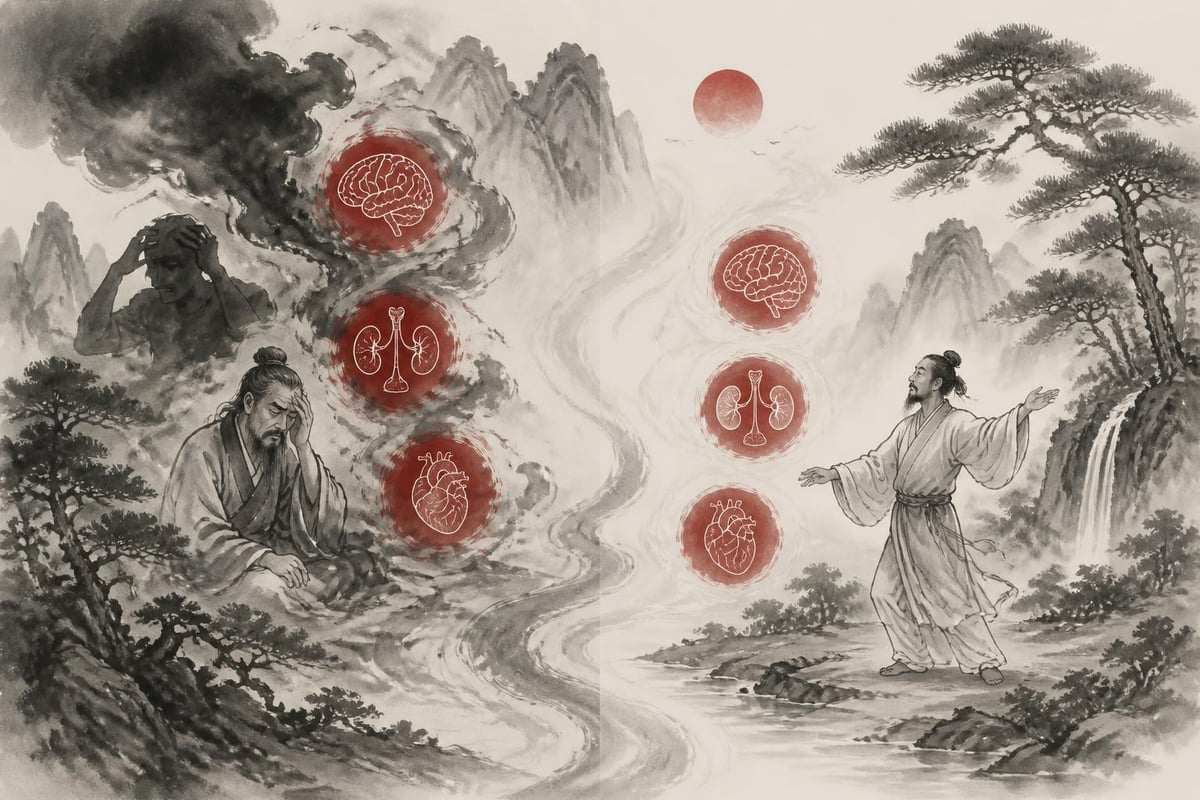
Qi gong belongs to a tradition that thinks of health as circulation. Where something stagnates - in the body, in the mind, in the mood -, one tries to reopen a passage. There is no promise: there is daily maintenance. Ten minutes in the morning near an open window is enough. One does not seek to "progress" - one seeks to return.
Qi gong is an art of living and a training for well-being - as a complement, never as a replacement for medical follow-up. For any health question (pregnancy, hypertension, chronic pathology), consult a health professional before starting a regular practice.
Article produced by artificial intelligence, reviewed under human editorial control.