Tai Chi and stress - what slowness really does to the body that spins too fast
Asian ArtsSubscribers only 2 h agoAdd to bookmarks
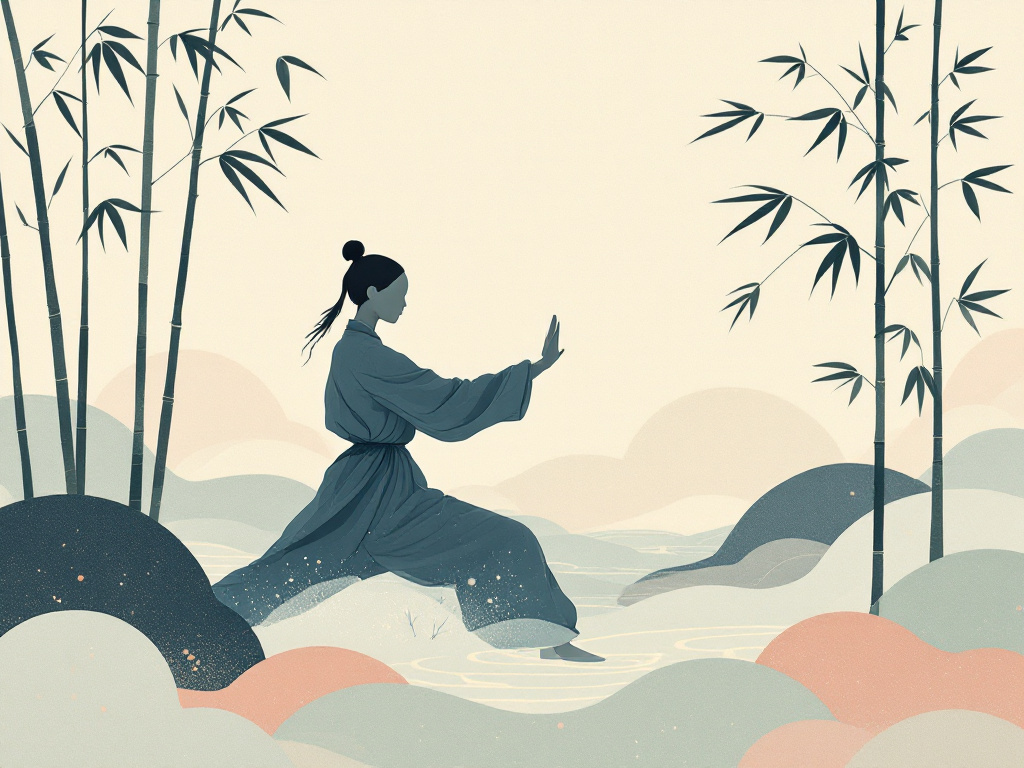
The art of moving slowly is not a poetic placebo: studies document measurable effects on stress and balance. What is well established, what is less so.
Context: from a martial art to a well-being practice
The Tài Jí Quán (太极拳), "supreme ultimate fist," has its roots in Chinese internal traditions, linked to the Wudang Mountains (Hubei) and the Chen lineage of Henan (central-north). It was formalized from the 17th century around the Chen family. Long an internal martial art reserved for initiates, it became popular in 20th-century China, notably through the Tai Chi Yang style, 24-movement form, standardized in 1956 for mass instruction. It is this form, often, that one encounters today in parks - from Shanghai to Paris.
Since the 2000s, it has been the subject of growing scientific interest, particularly in the United States (Harvard Medical School) and China, for its effects on balance, anxiety, and chronic stress. The key point: we are talking about well-being and prevention, never medical treatment.
What research says (with caution)
- On perceived stress and moderate anxiety, several systematic reviews show modest but reproducible effects, comparable to those of regular practice of gentle physical activity (brisk walking, slow swimming).
- On physiological markers (salivary cortisol, heart rate variability), the results are more heterogeneous: studies often lack solid control groups, and the magnitude of the effects varies according to the protocols.
- On fall prevention in seniors, however, the evidence is robust: Tai Chi significantly reduces the risk of falling, which explains its adoption in some geriatric programs.
In other words: we have a gentle practice whose benefits are neither miraculous nor anecdotal. It deserves to be presented for what it is - an art of movement that soothes - without making it a treatment.
Why it works: three convergent hypotheses
- Slow and continuous diaphragmatic breathing - stimulation of the parasympathetic nervous system, slowing of the heart rate, calming effect similar to that of cardiac coherence.
- Sustained body awareness - the slow movement forces consciousness to return to the body, which interrupts mental rumination loops.
- Progressive postural load - the light but constant muscle effort produces a "clean" fatigue that promotes deep sleep, without leaving residual excitement.
Three gestures to start at home
1. The Tai Chi walk (Yang step)
Feet parallel, width of the hips. Transfer all the weight onto the right leg, then advance the left foot heel first, very slowly. Place it down, transfer the weight. Five minutes are enough to change the texture of a day.
2. The opening of the hands
Standing, hands in front of the belly palms facing you. On the inhale, they slowly separate to the width of the shoulders; on the exhale, they close. Ten cycles.
3. The white crane spreads its wings (extract)
The arms rise while opening on the inhale, descend while closing on the exhale. Three times.
Precautions
- If you live with uncontrolled hypertension, balance problems, or joint pathology, talk to your doctor before starting.
- The practice of Tai Chi comes as a complement to follow-up; it does not replace drug treatment or psychotherapy for characterized anxiety disorders.
- Look for a serious teacher: a trained teacher (recognized federation, or identified Yang/Chen lineage) makes the difference.
What to remember
Tai Chi does not soothe because it would be "energetic" in the esoteric sense of the term, but because it combines slow breathing, body awareness, and progressive postural load - three levers whose effect on the nervous system is known today. Its strength lies in patient repetition: ten minutes a day are better than one hour a week.
As a complement, not a replacement - consult a health professional.
Content reserved for members
Create a free account to access all our content and the weekly review.
Article produced by artificial intelligence, reviewed under human editorial control.
The journey
Cheminement taoïste — mouvement et souffle
- 1The Tai Chi Walk - place one foot, listen to its weight18/07/2026
- 2Taoist meditation - tuning into the rhythms already present within oneself20/07/2026
- 3Tai Chi and stress - what slowness really does to the body that spins too fast22/07/2026