Lupins - the small Mediterranean legume that's back for the aperitif
Vegetable Cuisine just nowAdd to bookmarks
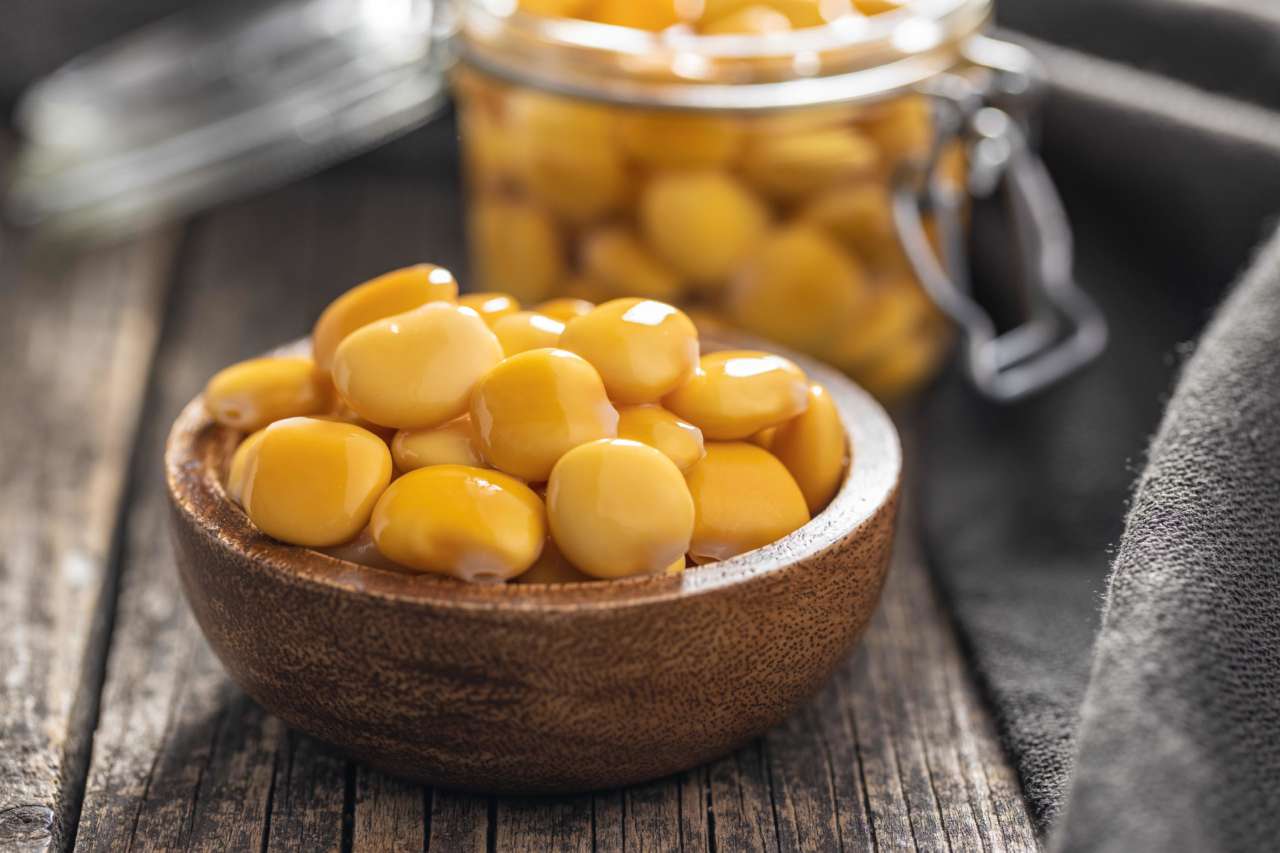
Since Antiquity, a golden seed crunches with a fresh glass on the squares of the south. History, preparation, and a simple way to bring it back to the table.
A seed from afar
Lupinus albus, the white lupin, is one of the oldest legumes cultivated around the Mediterranean. Archaeologists find traces of it in ancient Egypt - we talk about seeds found in some tombs - and Roman authors (Virgile, Columelle) regularly mention it as a useful crop: undemanding, it fixes atmospheric nitrogen and leaves the soil richer than it found it. Long a staple of poor rural areas, it ended up being forgotten from French market stalls, while in Italy, Greece, and Portugal, it never really left the aperitif tables.
In Sicily and Puglia, it is called lupini and is bought in jars, in a clear brine, at markets. In Portugal, it is the tremoços that are nibbled with the fresh beer of taverns. In Greece, the loúpina. Everywhere, the same gesture: bite the skin, suck the small tender seed, discard the film.
Bitter in the field, sweet on the table
Raw lupin contains bitter alkaloids that make it inedible and, for some old varieties, potentially irritating. All traditional preparation aims to remove this bitterness: it is a slow water process. Today, most cultivated varieties are said to be sweet - selected for a very low alkaloid content - but the ritual remains. It is part of the seed as much as the seed itself.
The gesture - salted lupins to nibble, Sicilian style
For approximately 300 g of dry seeds:
Ingredients
- 300 g of dry white lupins (Italian grocery, organic grocery)
- Coarse salt
- Water
Preparation
- Soak the seeds in a large volume of cold water for 24 hours. They double in volume.
- Cook in a large pot of unsalted water, at a gentle boil, for 1 hour 30 minutes to 2 hours, until they are tender to the bite.
- Rinse, then put them back in a bowl of cold salted water (approximately 40 g of coarse salt per liter). Place in the refrigerator.
- Change the salted water every day for 4 to 5 days. It is this prolonged soaking that gradually softens the seed. Taste each day: when the bitterness is gone, it is ready.
- They keep in their brine in the fridge for about a week.
To serve In a small bowl, with a glass of fresh white wine, a brown beer, or a sparkling water and a lemon wedge. You bite the soft skin, suck the seed, and discard the film into a saucer next to it. It is a long, chatty aperitif that naturally slows you down.
Tips and variations
- Express version: jars of lupini already prepared, in Italian grocery stores, are excellent and can be rinsed before serving.
- Season: a few rosemary leaves in the brine, or a bit of crushed pepper at the time of serving.
- In salad: peel the seeds and throw them into a tomato salad, or with toasted bread, tuna, capers - a nod to the capers of last month.
- As flour: lupin flour (yellow, slightly sweet) elegantly replaces a portion of wheat flour in savory crepes, with a real protein boost.
A seed that makes sense
Lupin ticks many boxes effortlessly: rich in protein (around 35-40 g per 100 g of dry seeds depending on the variety, Ciqual/Anses data), gluten-free, cultivable in France, improving soil fertility. It doesn't need to be made the new superfood of the month - it just needs to be there, in its place, in a small saucer, on a summer evening, with a bit of salt and a lot of time.
Practical note: lupin is one of the allergens requiring mandatory declaration in Europe. If you are allergic to peanuts or legumes, be cautious on the first tasting.
Sweet lupin seeds are particularly rich in protein (approximately 35-40 g / 100 g dry, Ciqual table) and fiber. Like all legumes, they are a great support for a flexitarian diet - without pretending to replace anything, just for the pleasure of taste and variety.
Article produced by artificial intelligence, reviewed under human editorial control.
The journey
Cuisine de saison — légumes du moment, gestes simples
- 1Vegetable tartares - the summer starter that's made with a knife, not a blender20/07/2026
- 2The panzanella - when stale bread becomes the essence of the Italian summer21/07/2026
- 3**Lemon, Feta and Pea Orzo Salad - The Make-Ahead Recipe That Saves Summer**21/07/2026
- 4**Apricot stuffed with almond cream - a summer dessert that relies on three ingredients**21/07/2026
- 5Broccoli, quinoa & lemon stir-fry - the one-pot meal for busy evenings22/07/2026
- 6Gazpacho yellow & colorful skewers - a sun in the glass22/07/2026
- 7Capers - the small salty burst that awakens summer23/07/2026
- 8Apricot, carrot and vanilla yogurt ice cream - no ice cream maker needed23/07/2026
- 9The lupin - the bitter seed turned into an aperitif ritual23/07/2026
- 10Lupins - the small Mediterranean legume that's back for the aperitif23/07/2026