The singing bowls - understanding the object before listening to it
20 h agoAdd to bookmarks
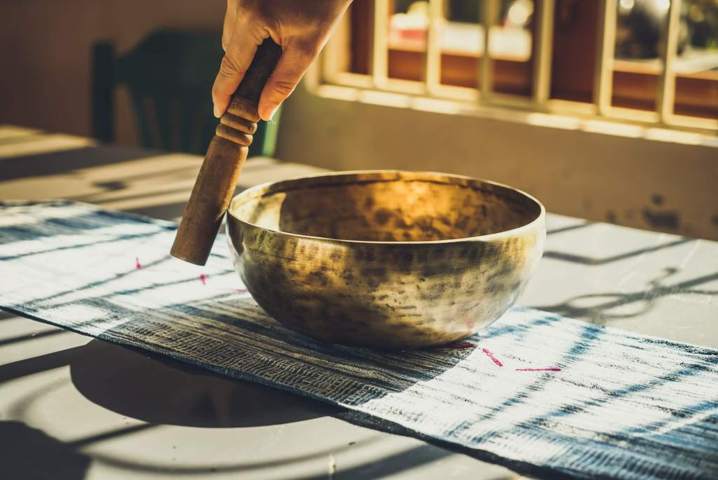
Before placing a bowl on the ground and letting the mallet spin around its edge, it's worth knowing what you have in your hands. Where do these bowls come from? How are they made? What exactly do you do when you make them sing? Here's an overview, without any therapeutic promises.
Where do singing bowls come from?
There are generally two main families.
Himalayan bowls - often called "Tibetan bowls", even though traditional production is centered on Nepal, the Indian Himalayan region and, historically, on Tibet and Bhutan. These are hand-hammered metal bowls, made according to lineages of artisans. Tradition speaks of an alloy of several metals (often seven), mixing copper, tin and a variable portion of other metals - this is what gives each bowl its own voice.
Crystal bowls - much more recent (late 20th century), made of molten quartz, industrially produced and often used in modern Western sound therapy studios. Their sound is more "pure", longer, more piercing than that of metal bowls, whose voice is layered with harmonics.
It is important to know that the "Tibetan tradition" of the singing bowl is actually a practice whose precise history is debated: Buddhist monasteries in Tibet and Nepal use other ritual instruments (bells ghanta, cymbals tingsha, gongs); the use of the bowl as a sound meditation object placed on the ground, as we know it in the West, has largely structured itself in the 20th century in contact with Western interest in Asia. In other words: it is an ancient object, but its contemporary meditative use is partly a meeting between the East and the West, and that's fine - provided we don't tell a story we can't prove.
How to make it sing
Two gestures are enough, to be discovered without haste.
The "struck" gesture - you hold the mallet (often made of wood covered with felt) like a pen, you give a soft blow on the side of the bowl. The sound rises, settles, decreases. You listen until the end of the silence - don't cut the sound by putting the mallet down too quickly.
The "turned" gesture (friction) - you hold the mallet vertically, against the outer lip of the bowl, and you turn slowly, regularly, pressing barely. The bowl starts to sing: it's a continuous resonance, which increases in intensity with the gesture. This movement is done without tensing - as if you were writing a circle on the edge.
A bowl placed on the open palm, a bowl placed on a flat cushion, a bowl placed on the ground in front of you: each of these positions modifies the way the sound propagates. There is no "right" way.
A simple listening ritual, at home
If you want to take a moment with a bowl in your living room, try this - once a week, no more at the beginning:
- Choose a moment without distraction: end of the day, low light, phone on silent.
- Sit comfortably, back straight without stiffness, the bowl in front of you.
- A soft strike. Listen to the sound until it has completely disappeared. That's the exercise.
- Repeat two or three times, no more. Don't try to "do something". The sound does the work.
We often think we need to
What we won't say
There are many discourses around singing bowls: "they rebalance the chakras", "they emit the miracle frequency of 432 Hz", "they cure insomnia / anxiety / pain". In this magazine, we talk about relaxation, listening, ritual - not healing. What we know for sure is that taking regular time for concentrated listening is a real moment of rest. That's already a lot, and it doesn't need any medical promise to be precious.
As a complement to medical follow-up, not as a replacement - for any difficulty with sleep, anxiety or persistent pain, consult a health professional.
Article produced by artificial intelligence, reviewed under human editorial control.
The journey
Univers sonore — écoute, vibration, rituels
- 1Six things sound does to the body and mind - a balanced overview18/07/2026
- 2432 hertz: the whispered frequency - what the vibration makes us feel19/07/2026
- 3Humming singing - when humming becomes an intimate practice19/07/2026
- 4The singing bowls - understanding the object before listening to it20/07/2026
- 5The sound bath - letting yourself be enveloped by the vibration, without expecting a miracle21/07/2026
- 6Bags in bronze or bags in crystal - two families, two resonances, a choice21/07/2026