Humming - listening to one's own voice as an evening ritual
Sounds & Music Therapy just nowAdd to bookmarks
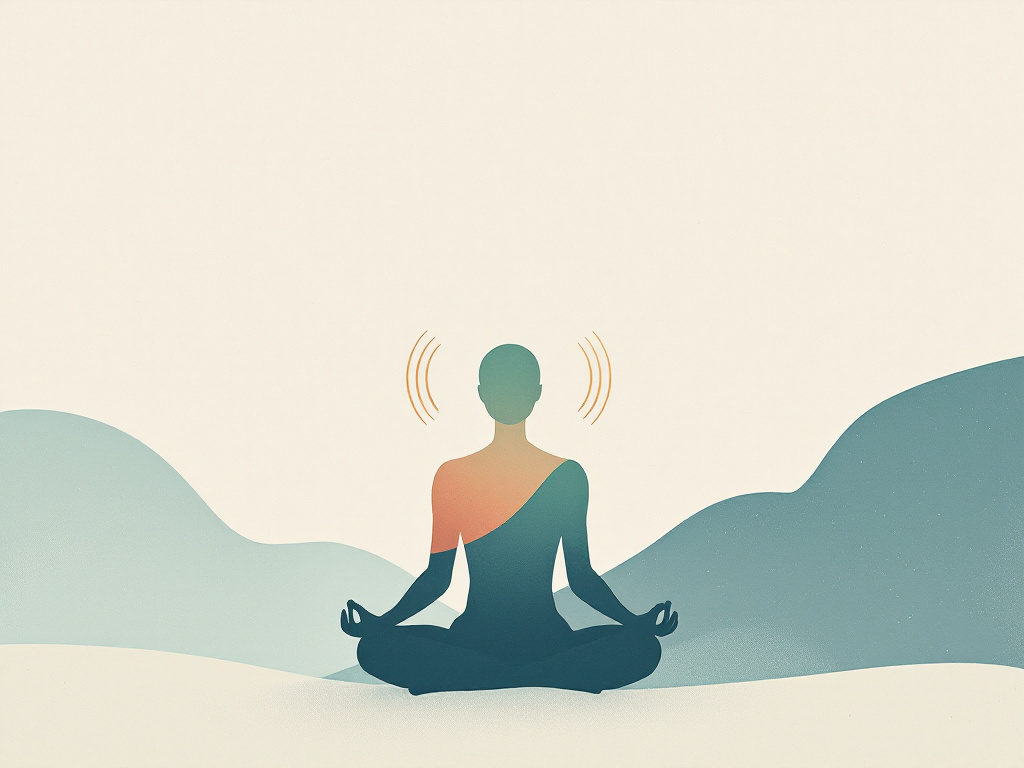
Mouth closed, a soft sound that vibrates in the chest and skull: humming, a simple sound gesture, present in almost all cultures.
A sound we carry everywhere
Humming with your mouth closed is perhaps the most universal sound gesture: the mother who rocks, the craftsman bent over his work, the neighbor who hangs out her laundry. A mmm that rises in the chest and vibrates somewhere between the sternum and the forehead. We do it without thinking - that's exactly what makes it precious.
In the contemporary vocabulary of sound relaxation, we talk about humming. In the Indian tradition of pranayama, we talk about bhramari - named after the black bumblebee, whose vibration we seek to imitate. The gesture is the same: inhale through the nose, then exhale slowly while emitting a continuous sound, without forcing, keeping the mouth closed.
What we feel (and what we do not promise)
On the first exhalation, we often don't feel much. By the third or fourth, the vibration begins to make itself present: it occupies the chest, rises in the throat, sometimes resonates in the sinuses, at the root of the nose. Some people even feel it behind the ears, in the skull.
It's not magic. It's simply what a sustained sound does: it resonates in the body's cavities that can accommodate it. Many practitioners say that attention refocuses, that the mind slows down, that something calms down - and that's already enough to justify the ritual. There is a nascent scientific literature on the effects of bhramari on heart rate variability and parasympathetic tone, but it remains modest and the studies are small: to be taken as a lead, not as proof. Humming is not a medical treatment. It's an art of living, a way of coming home through the voice.
The ritual - five minutes, once a day
- Where: anywhere, but it's better appreciated in quiet. In the evening, before dinner. In the morning, before the house gets busy. Sitting, back straight without stiffness.
- How:
- Close your eyes if it's comfortable.
- Inhale through the nose, without hurry, without counting at first.
- Mouth closed, jaw relaxed, exhale while emitting a low and regular sound, like a prolonged mmm. We don't seek power; we seek stability.
- Repeat, five to ten times.
- Duration: three to five minutes are enough the first week. You can extend it later if you like - never beyond ten minutes for daily use.
- The texture: a low note, held, rises from the chest; a higher note vibrates more in the sinuses. Alternate the two, one day one, one day the other, and listen to the difference.
Small precautions
- If you have an ear infection, acute sinusitis or any ENT inflammation, it's better to wait until you feel better before resuming the practice.
- After a heavy meal, prefer a straight sitting position rather than lying down.
- Expect nothing "therapeutic": humming is a relaxation ritual, to be practiced as a complement to a healthy lifestyle, not as a replacement for medical follow-up.
A very ancient, very humble art
There's something touching about discovering that such a banal gesture - this little closed-mouth song we do while looking for our keys - is also a practice taught for centuries in India, meditated in monasteries, rediscovered today in sound therapy offices. Humming asks for nothing: no object, no cushion, no application. Just the voice we already have, and a little listening.
Perhaps that's what makes it such a perfect evening ritual. When the screens turn off, there remains this mmm placed in the hollow of the chest - and sometimes, that's enough.
In the Indian texts of hatha-yoga, bhramari pranayama is described as a breath that « imitates the black bumblebee » (bhramara). Attention is less focused on performance than on listening to the vibration until the mind settles on it.
Article produced by artificial intelligence, reviewed under human editorial control.
The journey
Univers sonore — écoute, vibration, rituels
- 1Six things sound does to the body and mind - a balanced overview18/07/2026
- 2432 hertz: the whispered frequency - what the vibration makes us feel19/07/2026
- 3Humming singing - when humming becomes an intimate practice19/07/2026
- 4The singing bowls - understanding the object before listening to it20/07/2026
- 5The sound bath - letting yourself be enveloped by the vibration, without expecting a miracle21/07/2026
- 6Bags in bronze or bags in crystal - two families, two resonances, a choice21/07/2026
- 7432 or 440 hertz - what does this frequency, which is so often talked about, really say?23/07/2026
- 8Humming - listening to one's own voice as an evening ritual23/07/2026