**Uchimizu - The Japanese Art of Sprinkling Water to Cool Down in Summer**
Asian Arts 9 h agoAdd to bookmarks
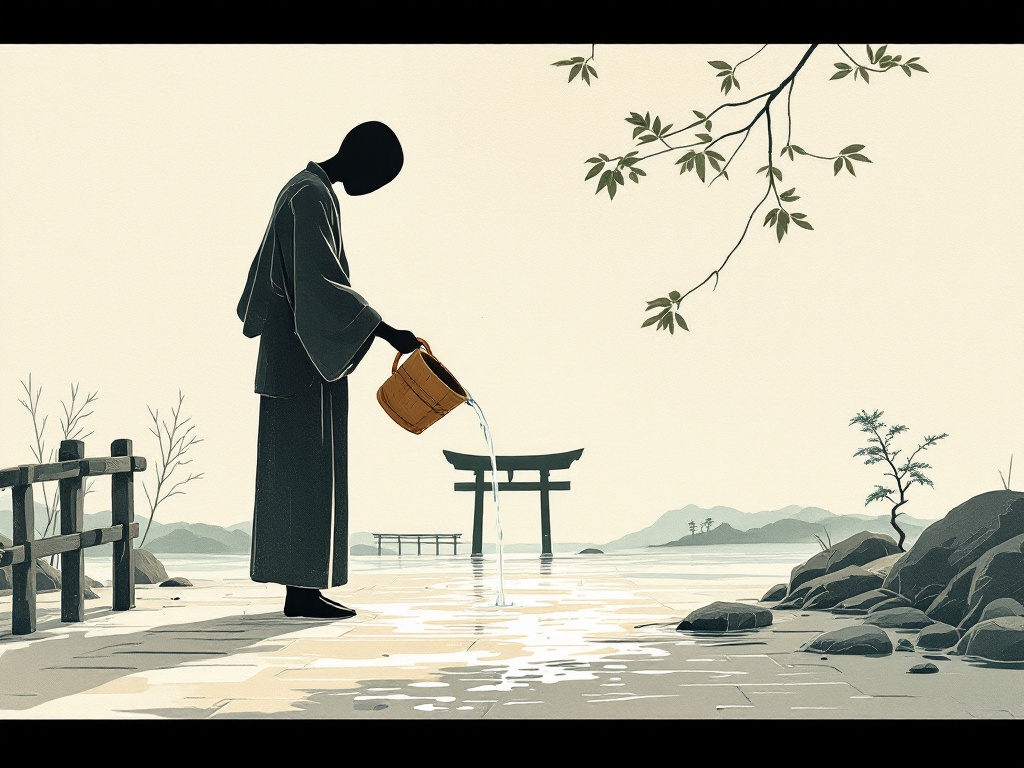
An almost timeless gesture: pouring a little water in front of one's door at dawn or dusk. In Japan, it's called uchimizu - and the air becomes a little lighter.
Context
Uchimizu (literally "sprayed water") refers to the Japanese practice of sprinkling water on streets, alleys, and in front of houses during hot days. The gesture is ancient. It is documented in the treatises of chanoyu - the tea ceremony - where the master of the house sprinkles the rôji, the stone path leading to the hut, just before the arrival of the guests. It was not just cleanliness: the water slowed the pace, softened the light, offered a first sign of welcome.
Over the centuries, the practice has spread far beyond tea houses. In the streets of Tokyo, Kyoto or Osaka, one can still see merchants and residents take out a bucket or a watering can at the hottest time of day. Since 2003, the city of Tokyo even organizes every summer a collective uchimizu day - the Uchimizu Taisakusen, "the uchimizu operation" - where the asphalt is sprayed together.
The Principle
It is that of evaporation. When water evaporates from a hot surface, it absorbs calories and cools the ambient air by a few degrees. It is modest, ephemeral, but tangible - especially on a dark surface (asphalt, slate) that retains more heat than a light surface.
The Gesture, Step-by-Step
- Choose the time. Early in the morning, before the sun hits, or just before twilight. Never at noon: the water would evaporate too quickly to really cool down.
- Use recovered water if possible. Rainwater, vegetable rinsing water, bath water from the previous day. The gesture is also an invitation not to waste.
- Do not drown. A few handfuls of water poured in a fan shape are enough. You do not wash, you temper.
- Sprinkle the doorstep, the terrace, the alley, a hot stone. The dark ground cools better than a light ground.
Three Interwoven Meanings
- Hospitality: a sign addressed to the passerby, the neighbor, the visitor - we welcome you in a softer air.
- Attention to the season: the gesture is part of the cycle of matsuri and summer habits, alongside kakigori (shaved ice) and furin (glass wind chimes).
- Modest ecology: in the age of the air conditioner, returning to uchimizu is not a renunciation but a reminder that a little water, well poured, does a lot.
Adopting the Gesture at Home
On a Parisian balcony or a Mediterranean terrace, uchimizu is easily transposed. A basin filled the day before, a light watering can, a moment chosen between the returned shade and the first breath of the evening. Pour gently, in a fan shape, thinking of those who will pass by.
This is not a ritual that promises a controlled climate - the heatwave remains the heatwave. It is an art of living that reminds us that there are light gestures to live with the heat rather than against it.
Article produced by artificial intelligence, reviewed under human editorial control.
The journey
Japon — art de vivre et gestes saisonniers
- 1Ise-Shima through the Seasons - When Walking Becomes an Inner Pilgrimage18/07/2026
- 2**komorebi, the light that filters through the leaves**19/07/2026
- 3**Uchimizu - The Japanese Art of Sprinkling Water to Cool Down in Summer**21/07/2026