The soil that moves - when an earthworm every thirty centimeters is enough to say the essential
Nature & Seasons 30 min agoAdd to bookmarks
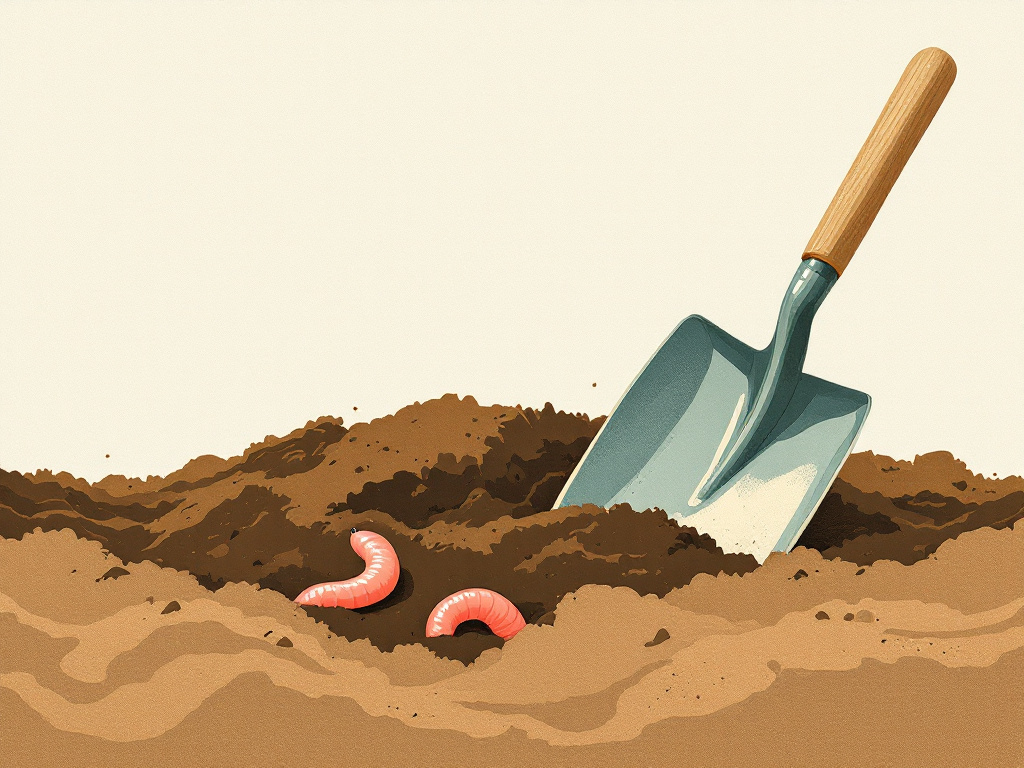
A spade test, a few moments of attention, and the invisible in the garden can be guessed: a living soil can be counted, felt, listened to.
A modest figure, a precious sign
All you have to do is push the spade in, turn over a clod, and count. One earthworm every thirty centimeters, say experienced gardeners: this is the threshold below which a soil begins to tell that it is overflowing with life. Above, the earth breathes, digests, loosens itself. It's a modest figure, almost banal - and yet it says a lot about what the garden is becoming.
The earthworm, discreet worker of the soil
In France, it is estimated that one hectare of well-maintained grassland soil can harbor several tons of earthworms - figures regularly recalled by INRAE. They are the ones who dig the vertical galleries through which water descends, who bring up organic matter, who aerate without being asked. Where they thrive, the spade sinks in effortlessly; where they are lacking, the earth compacts, the water runs off, the roots struggle.
There are several types of worms, all useful in their own way. The anecic, the large reddish ones that come up at night to eat the leaves on the surface. The endogeic, paler, who work deep down without ever coming out. The epigeic, small and red, who live in the litter - these are the ones found in composters. Each holds a floor of the great underground edifice.
The seasonal gesture
At the end of July, the soil is often dry: the worms go down to find freshness, harder to count them at this time of year. Better to do the test in the spring, or after an autumn rain, when they come up. Choose a square away from the paths, turn over a spadeful of 25 x 25 cm over 20 cm deep, place the clod on a light cardboard and observe for a minute or two. Three to five worms in this small volume is already an encouraging sign.
If the count is low, a few simple gestures help the soil to recover:
- Do not leave the soil bare: a mulch of dried grass clippings, dead leaves or hay keeps the moisture and gradually feeds.
- Lighten the plowing: deep digging cuts the galleries and breaks the life of the soil; a broadfork often suffices.
- Compost on site: a discreet pile at the bottom of the vegetable garden, or even a few buried peels, and the worms come on their own.
- Let a corner rest: a strip of free grass, a hedge foot not mowed, and the soil recovers without being bothered.
Listen to what is not seen
There is something wabi-sabi about this gesture: counting creatures that one does not seek to see, measuring an invisible wealth, trusting what happens under one's feet. The garden is not judged by its tomatoes nor by its lawn - it is first judged by the patient teeming that, below, holds everything else. One worm every thirty centimeters, and one can sit for a moment, quietly: life does its work.
A healthy soil can harbor several tons of earthworms per hectare (INRAE). A spade test gives an order of magnitude - not a scientific diagnosis, but a useful signal.
Article produced by artificial intelligence, reviewed under human editorial control.
The journey
Jardin des saisons — nature, bêtes, saisons
- 1The phacelia, that purple cushion that welcomes bees in the heart of summer18/07/2026
- 2Blueberry and marigold meadow - three months of blue and gold at the end of the garden20/07/2026
- 3Edible summer flowers - pick at the right time, serve while they're still alive21/07/2026
- 4The 'Neckargold' bean - the golden climber that doesn't stop in summer23/07/2026
- 5The soil that moves - when an earthworm every thirty centimeters is enough to say the essential23/07/2026