Taoist meditation - tuning into the rhythms already present within oneself
Asian Arts yesterdayAdd to bookmarks
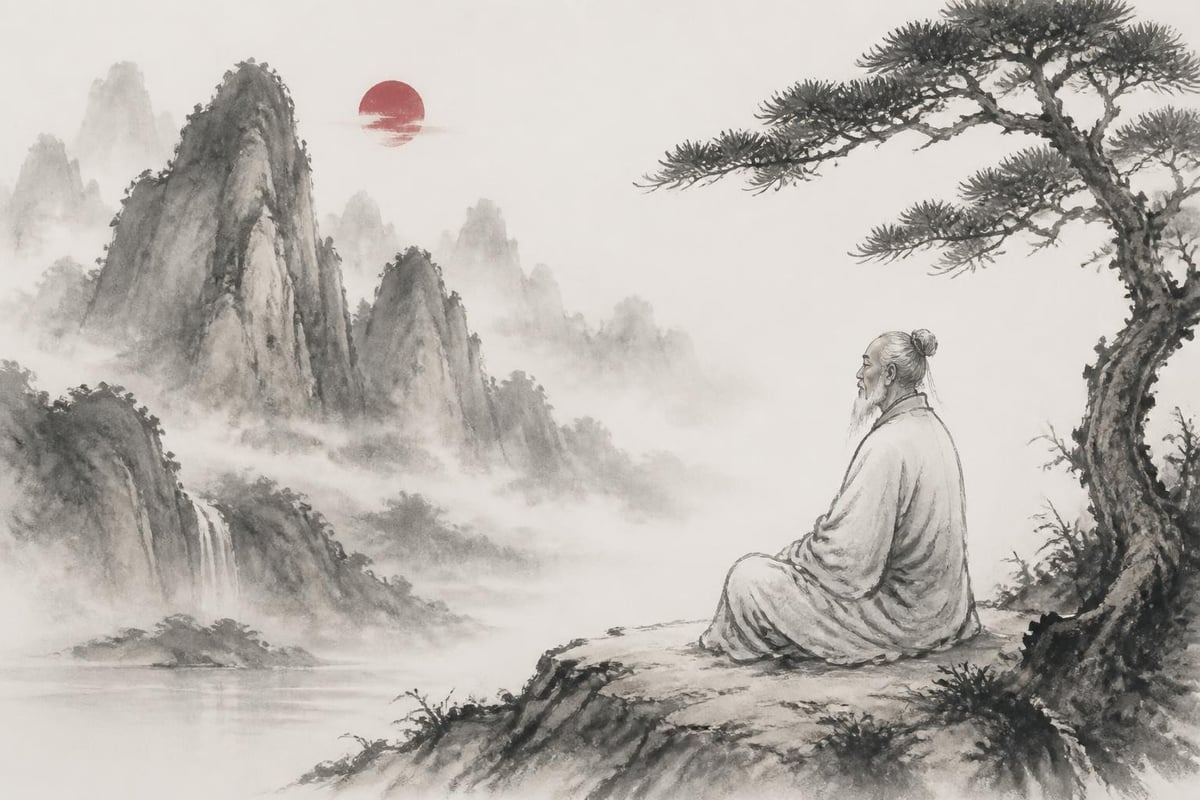
Far from wanting to "empty the mind," Taoist meditation (道家静坐, *dàojiā jìngzuò*) works with the breath and the energy that the body already carries. A seated step, complementary to the walking of Tai Chi.
Another Approach to Silence
In the West, when we hear "meditation," we often think of emptying the mind, silencing thoughts as if turning off a lamp. The Taoist tradition takes a different approach. It does not seek to erase what passes through the mind: it observes, it accompanies, it lets things settle. The classical term is 道家静坐 (dàojiā jìngzuò, literally "Taoist quiet sitting"), and this practice is seen as a patient art of living, a daily companion - never as a remedy.
What distinguishes it is its intention: rather than forcing calm, it aligns with rhythms already present in the body. Breathing, circulation, the warmth of the hands. Nothing is added; we just listen better.
The Gesture, Step by Step
Here is a simple entry, drawn from the guidelines transmitted in the temples of the Wudang Mountains, where this practice is still taught today:
- Sit - on a chair or cross-legged, it doesn't matter. The back straight without being stiff, like a string pulled from the top of the skull. Hands placed flat on the thighs, or cupped one in the other at the level of the lower abdomen, the thumbs gently touching.
- Feel the weight - a few seconds to let the body find its seat. Feel the points of contact: the buttocks, the feet, the hands.
- Let the breath come - without regulating it. Just notice that it enters, that it exits, that it descends a little lower into the belly each time.
- Place attention in the dāntián (丹田) - the point located three finger-widths below the navel, a bit inward. In thought only: we "place" the attention there as one would place a hand. It is the lower energy center of the Taoist tradition, where the breath comes to find refuge.
- Stay there for ten minutes - ten minutes is already a lot to start with. You can extend it later.
When a thought arises - and it will arise - we do not chase it away. We greet it, like a passing cloud, and we return to the belly. That's all.
What the Tradition Says, What Science Says
Taoist meditation belongs to the same family as Qi Gong and Tai Chi: three cousin practices, born in the same mountains, that complement each other. Qi Gong sets the breath in motion, Tai Chi sets it in motion, seated meditation lets it settle. Taoists speak of a single principle - 气 (qì, vital breath) - that runs through these three forms.
On the scientific side, meditation in general (all traditions combined) is the subject of numerous studies on stress and sleep, with generally encouraging but variable results depending on the protocols. That said, in the tradition we are concerned with today, one does not sit down to obtain a measurable result. One sits down to be there, for a moment, with oneself.
A Companion, Not a Treatment
On questions of anxiety, difficulty sleeping, rumination - it's in addition to follow-up, never as a replacement. If you are going through a difficult period, consult a health professional. The seated practice can accompany, it cannot heal.
But it can, over time, offer ten minutes a day where one is not rushed, where one expects nothing, where one is simply sitting in the middle of one's own breath. That's already a lot.
In the thread of the Taoist journey that we are exploring here issue after issue, this seated meditation comes to extend the walk of Tai Chi and the gestures of Qi Gong: three ways to let the body remember that it knows how to breathe.
Article produced by artificial intelligence, reviewed under human editorial control.
The journey
Cheminement taoïste — mouvement et souffle
- 1The Tai Chi Walk - place one foot, listen to its weight18/07/2026
- 2Taoist meditation - tuning into the rhythms already present within oneself20/07/2026